

Part 1 — Three Worlds, Three Forces, and Finding Three Everywhere
Part 2 — Ukhu Pacha: The World Below
Part 3 — Kay Pacha: The World We Walk In
At the end of our visit to Kay Pacha, we left the puma carefully considering the next place to put its feet. Every muscle was involved in that decision. There was ground to feel, a scent to follow, perhaps danger to avoid or food to find.
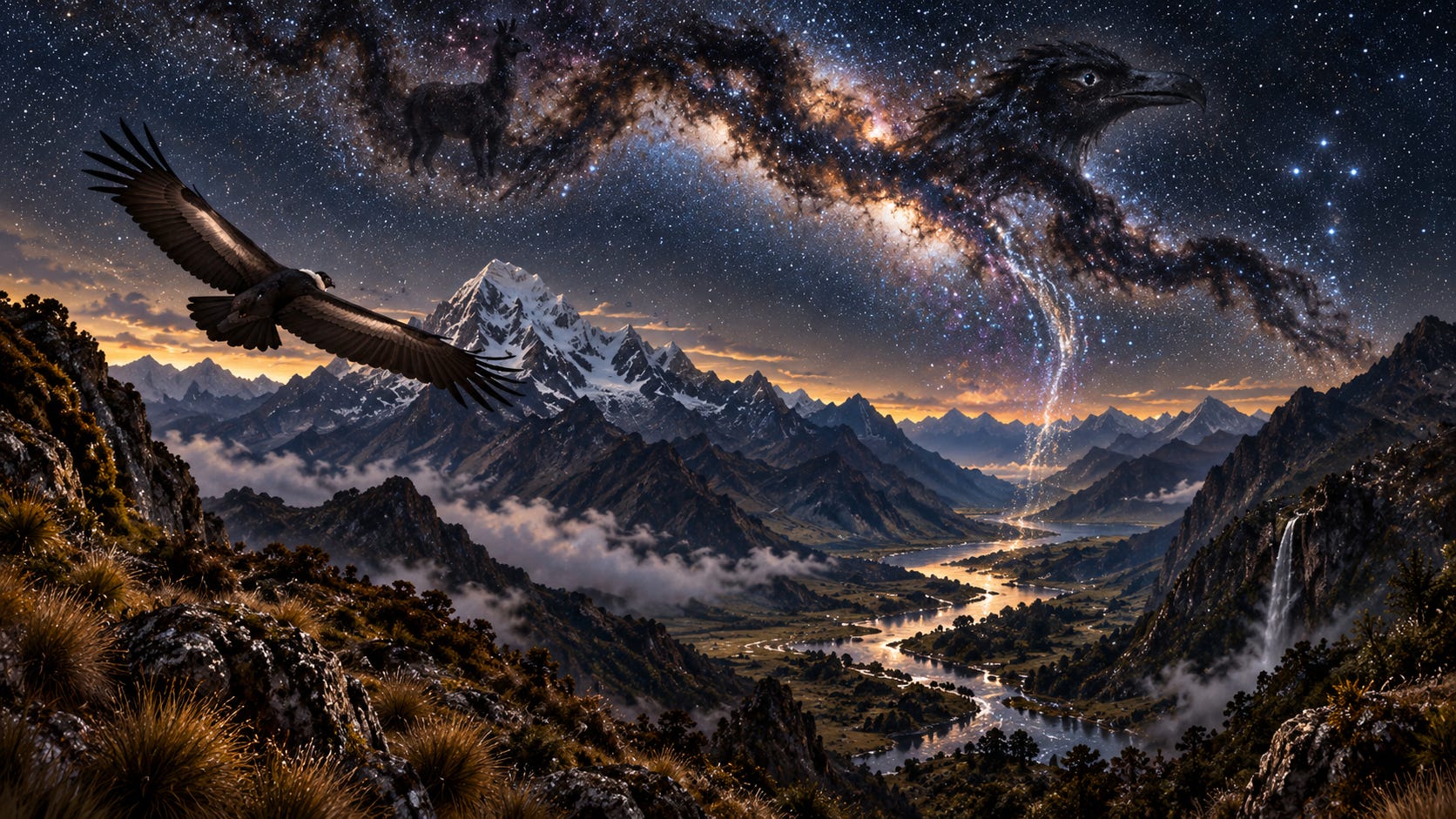
Now imagine a condor above that same patch of earth. Its wings are spread, the long feathers at their tips slightly separated. With a small adjustment of its wing, the bird turns. Below it, the puma’s trail disappears into a mountainside. The mountainside opens into a valley. A river, unseen from the trail, bends through it all.
The ground has not changed, but the view has changed enormously. This brings us to Hanaq Pacha, the world above. We’ve traveled through what is hidden beneath us and with the world we walk in. Now we lift our eyes and prepare to fly.
The Upper World
Hanaq Pacha, (also written Hanan Pacha) is the place of the upper world; the world above. To review, pacha holds more than our word “world.” It includes time, space, place, and the life unfolding within them.
In the Andean three-world teachings we have been exploring, this is the realm of the great celestial powers: Inti, the sun; Mama Quilla, the moon; Illapa, thunder and lightning; the stars; and other beings of the sky.
There is a temptation to translate this as “heaven,” then furnish it with whatever ideas we grew up with and expect to find those there. Pearly gates, perhaps. A reception desk. Some complicated rules concerning admission. Wings and harps. Hanaq Pacha has its own histories and inhabitants. We can learn and experience much by opening enough to allow it to remain itself.
The sun that warms a field, the moon passing through its phases, the stars appearing at particular times of year: these have immediate consequences for life below. Sacredness and usefulness occupy the same sky. A person looking upward might be considering a crop, a ceremony, the coming rains, or the nature of existence.
The River in the Sky
Look up on a clear night far from electric lights and the sky can offer a different kind of teaching. Across it runs the pale, irregular band of the Milky Way. Dark stretches pass through it. The longer the eyes adjust, the more that can be seen.
In Quechua, mayu means river. Andean sky traditions call the Milky Way Mayu, the celestial river. In traditions around Cusco, Mayu and the Vilcanota are the same great river, one flowing through the sky and the other across the earth. Water circulates between them. In this tradition, Mayu becomes the source of all water on earth.
The headwaters of the Amazon rise high in the Andes. Little streams become larger ones. They join other streams, then rivers, eventually becoming a system so enormous that in places the opposite bank disappears beyond the horizon.
Among the most remarkable inhabitants of this river are the dark constellations. Many of us learned to find figures by connecting bright stars: a hunter here, a bear there. In parts of the Andes, people saw animals in the black spaces inside the Milky Way.
Andean observers saw living beings there: a llama and her young, a fox, a toad, a serpent, and a tinamou. These were living relationships. Their appearance in the sky corresponded with rainfall, agricultural cycles, and the behavior of animals on earth.
One of the great figures is Yacana, the celestial llama. Alpha and Beta Centauri mark her eyes. Yacana was also part of the seasonal calendar. Her movement through the sky was associated with the rains and agricultural cycle, and around the December solstice her head appeared to dip toward the earthly river to drink.
An early colonial account from Huarochirí, in the central Peruvian Andes, tells of Yacana coming down at midnight to drink from the sea. If she failed to drink, the waters would rise and flood the world. Other Andean traditions connect her with the rainy season and the return of water to the mountains.
And in some traditions the explanation becomes beautifully blunt: The black llama drinks from the sea and urinates the water back onto the earth as rain. So much for an ethereal upper world.
We began with the world below, a realm of darkness, and the world above, a realm of light. Now a dark animal appears in the heavens, drinking from the sea. In Ukhu Pacha we met Amaru, the serpent of underground waters, rising across the sky as a rainbow and returning to the earth through another spring.
The three worlds keep entering one another. The serpent rises out of the depths. The celestial llama comes down to drink. Water moves between earth and sky, and life depends on the exchange.
Pleiadean Potatoes
The Pleiades offered another kind of information. Andean potato farmers watched them closely around the June solstice. Some years the cluster appeared bright and sharp. In others it seemed muted, almost veiled. That difference mattered. A muted Pleiades warned of poor or delayed rains, and farmers postponed planting their potatoes.
Centuries later, researchers discovered something remarkable. During El Niño years, thin clouds high in the atmosphere can partially obscure the Pleiades. Those same weather conditions tend to bring reduced rainfall to the Andes months later. The farmers had learned to read a connection between stars, clouds, ocean, rain, and potatoes long before modern meteorology could explain why it worked.
I have no idea how much knowledge that may have been lost lies behind these stories. Much of the context that once surrounded them may simply be gone.
The Condor
A condor spends much of its time in the air being carried. Warm air rises. Wind moves against a mountainside and turns upward. The bird feels these movements through its body and makes adjustments that let it fly with little effort. There is tremendous sensitivity in what looks, from below, like doing almost nothing.
We human beings generally prefer effort we can recognize. Try harder. Type faster. Concentrate harder. Try to become more spiritual by forehead-clenching force of will. Then we get irritated if the neighbor in the next seat makes noise while we try to find peace.
The condor suggests another possibility. Some movements become available when we stop fighting the conditions that could carry us.
Another side of the condor is uncomfortable. It is also a vulture, obliged by its biology to eat the dead. Carrion is what enables it to live.
Condors descend on puma kills and eat from the carcass. The puma of Kay Pacha and the condor of Hanaq Pacha meet at the same body.
The condor does not transcend death. It eats it.
Then it rises again.
The same bird that sees the valley as a whole also sees where death has entered it. Its view includes the river, the mountainside, the puma, the carcass, the wind, and whatever lies beyond the next ridge.
Something like this can happen in a human life. An event that seemed to ruin everything may eventually reveal a direction we could never have chosen at the time. A family argument may look different when we begin to see the histories carried by everyone in the room. The hurt remains real as the field around it gets larger.
We can sometimes see a little more of what another person is carrying, and occasionally what we have been carrying ourselves.
There is more here in the condor and its relationship with death. I am going to leave it alone for now. We will revisit it in a future writing.
When the Sky Opens
As with Ukhu Pacha, I am interested in what this world may reveal about ourselves. That is my exploration, growing out of these teachings. Human consciousness sometimes seems able to move beyond the boundaries within which it ordinarily lives. We see relationships, histories, and patterns that were invisible from inside our usual point of view.
There are experiences for which our ordinary vocabulary is embarrassingly small. Someone sits quietly for a long time, and the boundary between listener and sound becomes difficult to find. Someone enters deeply into music and, for a little while, cannot find the place where the music ends and they begin. A person looks into a night sky so full of stars that their own thoughts fall silent. Awareness remains, with considerably less commentary attached to it.
Prayer can open this territory. So can meditation, love, grief, beauty, ayahuasca, huachuma, and other sacred medicines. The entrance may arrive in a ceremony that took months to prepare for. It may also arrive while watching light move across a wall or the song of a bird in a nearby tree.
Within these experiences. some find a presence. Others describe vastness, light, or an intelligence that seems to exceed anything they could have even imagined. Sometimes the experience is of being loved with an intimacy that makes very little sense to the ordinary mind. There may be nobody visible doing the loving. Trying to explain this afterward can be awkward.
Other experiences contain almost no imagery. There is a profound stillness. A dog barks. A truck goes by. Somebody drops something in the next room. The stillness remains.
There are also people who, during trauma, say that they went somewhere else, as though they watched from above. Others say they disappeared. Others enter through deep meditation, mystical experience, dissociation, trance, ayahuasca, and other altered. And the language can be very similar.
“I went somewhere.” A question to hold might be where is that somewhere?
Such experiences need time. We are quick to name what happened, particularly when something has touched us deeply. The name may be God, consciousness, spirit, the Divine, trauma, dissociation, enlightenment, or something we learned at a retreat. A name can help us speak. It can also become the point where the inexplicable gets explained and turns into yet another story..
Hanaq Pacha gives us somewhere else to look. The upper world leaves room for the possibility that ordinary identity occupies only a portion of what human beings are capable of experiencing. I have spent enough time around mystery to know that certainty is almost always premature. Some experiences deserve to remain unexplained. Besides, once explained, the experience is likely to be lost. And sometimes the most accurate thing I can say is, “I don’t know.”
If you got this far, please hit the “like” button below. It lets me know that this has been read and helps give me the motivation to go through the many hours of research and writing that go into these pieces.
If something in these words stirred something in you, I’d love to hear it. These conversations matter more than ever, and I appreciate it and will do my best to respond to any questions that may arise from reading them. Or if there is a topic you would like me to cover, you can reply here:
And of course, please subscribe if you are not already!
And finally, if you would like to work with me or just send a message or comment, click below.

I learned the shamanic journey through different traditions, so getting to sip from these profound wisdom perspectives is such an expansive experience for me. I have experienced a but small piece of this river that runs through the three worlds, but didn’t quite have the language to describe the exchange. Thank you for this heart-centered writing!
Richard, I so enjoy these profound writings. Thank you so much for the generous sharing.