

Part 1 — Three Worlds, Three Forces, and Finding Three Everywhere
Part 2 — Ukhu Pacha: The World Below
Kay Pacha: The World We Walk In
In the last Cosmic Threesome post, we explored Ukhu Pacha, the world below. Now we will move into the more familiar territory of Kay Pacha, pronounced more like “Kai,” what most people call “the real world.”
And, as with any discussion of the three worlds, there will be some mixing with the other two as we continue this conversation.
Kay Pacha is the world we know most intimately because it is the world of our waking life. From the time our eyes open in the morning until they close at night, it is where we live. We wake up here, eat here, work here, make love here, argue here, drive our cars and fly in airplanes, watch television, pay bills, have babies, and grow old. We measure things, name things, build houses and roads, plant gardens, bury our dead, and make plans for our next vacation or trip to the market.
There is no perfect translation, but in Quechua, kay means something close to “this,” “here,” or “present.” Pacha is harder to translate. It can mean world, place, time, space, realm, or some weave of all of them. Kay Pacha is this world, this place, this time. The world we can touch, the world our feet walk on.
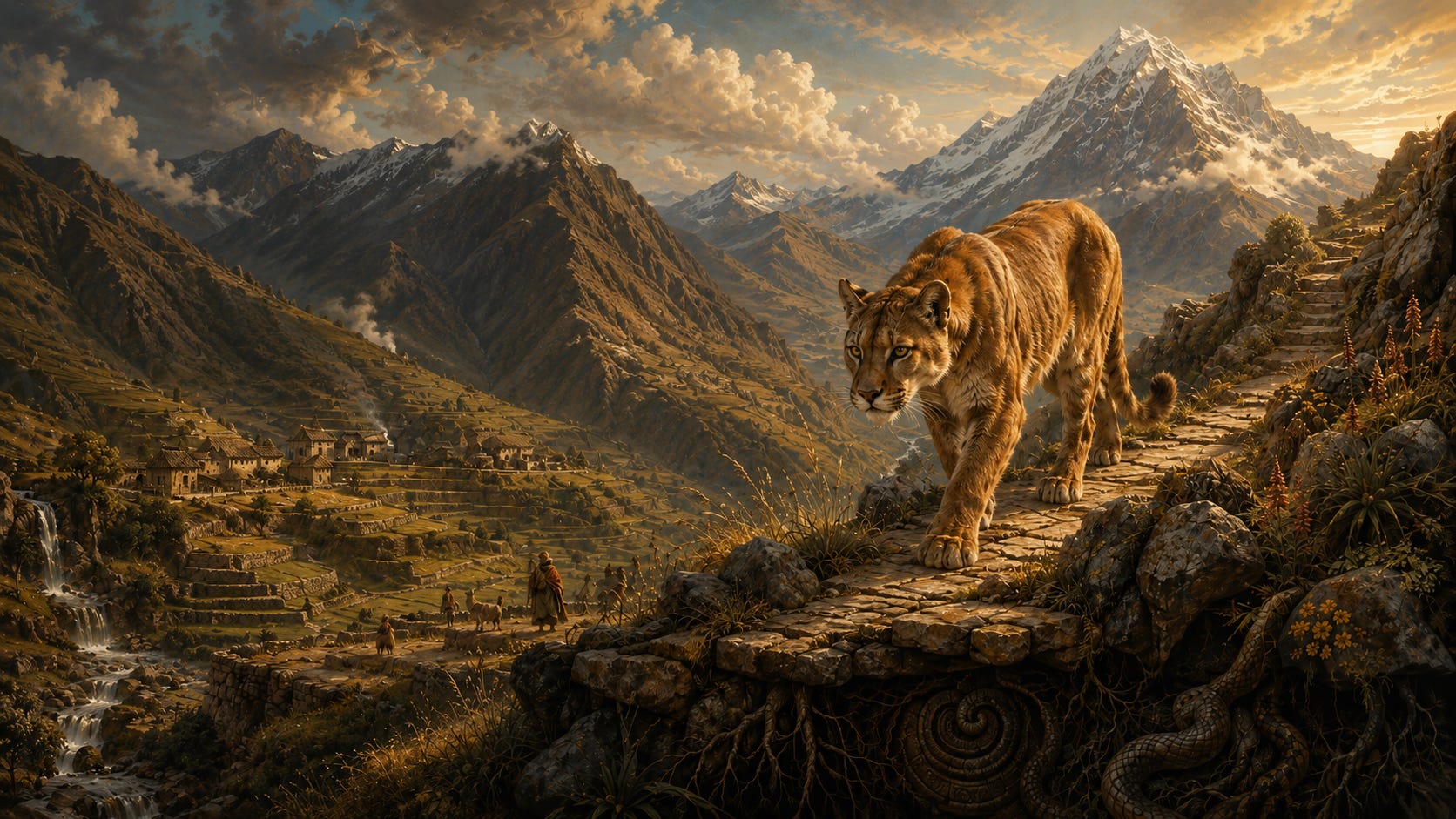
As Ukhu Pacha is associated with the serpent or anaconda, Kay Pacha is traditionally associated with the puma. And like the anaconda, the puma can be a remarkable teacher. For a moment, imagine watching one. A puma has an extraordinary awareness of exactly where it puts its feet. As a predator, it is acutely aware of sounds, smells, and movement. Every step matters. One careless footfall could snap a stick and scare dinner away.
You can get some sense of this by watching a cat walk along the top of a fence. Each foot is carefully placed exactly where it needs to land. The animal is exquisitely aware of its surroundings, and its muscles, eyes, ears, and balance give it a gracefulness few other animals possess.
This matters because Kay Pacha can be a dangerous place. There are cliffs here, snakes, sickness, injury, violence, betrayal, hunger, earthquakes, and bad decisions. A guide in Peru once told me a tragic story about a young couple on a long trek in the Andes. They were blissfully aware of only each other, talking, looking deeply into each other’s eyes, and having a wonderful time. Too wonderful, because when the trail made a sharp and sudden turn, they missed it and walked over a large cliff. Their bodies were never recovered.
A puma would not walk off a cliff.
And Kay Pacha is a wondrous place. There are peaches, falling in love, orgasms, successes, puppies, music, sunlight coming through leaves, grandchildren, friends, hot soup, astounding vistas, and rain after a long dry season. All meant to be cherished and enjoyed.
Danger and beauty. Mangoes and rattlesnakes. Walks on the beach and crossing a busy intersection.
Kay Pacha.
The Middle World
In the Andean three-world cosmology, Kay Pacha lies between Ukhu Pacha below and Hanaq Pacha above. Ukhu Pacha is the hidden world, the world beneath, associated with ancestors, seeds, death, gestation, memory, the unconscious, and the serpent. Hanaq Pacha is the upper world, associated with the sky, the sun, stars, gods, vision, and the condor.
Kay Pacha is where we meet.
The human being stands in the middle. We carry the hidden world inside us. Ancestors live in our bodies, our genes, our stories, our fears, and our habits. Things buried long ago continue to push shoots through the soil. Above us are ideals, visions, dreams, gods, stars, imagination, possibility. Here we are in the middle, with mud on our shoes and bills to pay. This is where the three worlds take form as human life.
Many think of the three pachas as separate realms, one above another, one below the other. This makes them easy to grasp. But lived cosmology is messier and more complex than a simple picture. Ukhu Pacha, Kay Pacha, and Hanaq Pacha continually enter and interact with one another.
Ukhu Pacha rises into this world through ancestry, memory, instinct, dreams, seeds, death, fertility, and everything that has been forming below the surface. A fear buried for decades can shape a marriage or break a child. Ancestral wounds can become an unrecognized milieu that shapes how a family functions, relates, and sees the world. A seed disappears into the dark and later breaks through the soil as food. The dead remain present in stories, customs, faces, gestures, and sometimes in dreams vivid enough to alter the following day or even many years of a life.
Hanaq Pacha enters from above. Light, weather, celestial cycles, visions, ideals, revelations, and the larger patterns by which people orient themselves all descend into ordinary life. A dream becomes a decision. A vision becomes a painting. A prayer becomes an act of nobility, courage, and kindness. Something encountered in ceremony becomes the way a person speaks to his wife the following morning.
Kay Pacha is where these movements become visible. This is where the hidden acquires hands, where vision becomes action, where memory becomes behavior, where possibility becomes choice. Nothing stays purely above or below once it enters a human life.
The Beauty of Sacred Reciprocity
Of all the Andean ideas I have encountered, I find the idea of Ayni to be the most beautiful. Ayni predates the Inca Empire. The Inca inherited older Andean systems of reciprocal obligation and organized enormous parts of society around them. Related forms of communal labor operated at different scales, from exchange between households to work done for the community and labor owed to the state. Economics, agriculture, social organization, and spirituality were woven together.
A potato field was practical and sacred at the same time. It was also a relationship. Ayni assumes something modern life makes surprisingly easy to forget: nothing exists alone.
The food on my plate requires soil, rain, sunlight, microbes, insects, farmers, seeds, trucks, roads, fuel, markets, money, and thousands of years of people saving the right plants. Even breathing is reciprocal. I take oxygen and give carbon dioxide. The trees take in carbon dioxide and release oxygen, another part of the exchange that sustains life.
All of the world lives in this kind of exchange. Disharmony begins where this is forgotten.
Ayni teaches us how to live in Kay Pacha. It could be imagined as a circular chain of reciprocity moving through the community. If you need help planting your field, I help you. Later, you may help someone repair their roof. They may help another family bring in a harvest. When my family needs help, the chain eventually circles around again.
There is something here that reminds me of Karma Yoga, the practice of making service itself a way of living. Ayni carries an additional sense of mutual responsibility. People help because this is how a community survives and remains whole. The exchange may return through another person, at another time, in another form.
The chain does not end with people. Humans owe something to Pachamama, to the mountains, to the water, and to the forces that sustain life. In the Andes, reciprocity reaches beyond the human community.
Offerings move between people and Pachamama, the Apus, ancestors, animals, water, weather, and sacred powers. People give thanks, food, drink, coca, labor, attention, and reverence. Rain comes, crops grow, animals reproduce, families are protected, and life continues. The exchange moves through all three pachas.
We are shaped by what came before us, pulled by what calls from beyond us, and forced to place our feet somewhere in the present.
Kay Pacha is where the worlds touch.
The World We Decided Was Real
Over a very long stretch of human history, much of the modern world came to give ordinary waking consciousness a special authority. The world we could see, touch, measure, and agree upon became the version of reality we trusted most. Dreams, visions, ancestors, spirits, trance, and other kinds of experience were gradually pushed into religion, superstition, mythology, psychology, imagination, or metaphor.
This did not happen everywhere or all at once. For much of human existence, the borders were far more permeable. Dreams could be messages from the gods. Ancestors could remain active members of a family long after their bodies became dust. Mountains could possess presence and wisdom. Spirits were consulted. Oracles would influence affairs of state. People entered trance deliberately, and sacred plants opened doors into other realms of perception. A dream could tell someone where to hunt, whom to marry, where danger waited, or what an ancestor required.
The Greeks slept in temples hoping to receive healing dreams from Asklepios. Tibetan traditions developed sophisticated practices involving dreams, bardos, and states of consciousness beyond ordinary waking awareness. Among many Indigenous peoples, the dead never became entirely absent, and the landscape itself remained populated by intelligence. In the Andes, the Apus, the great mountain beings, were never simply geological formations.
The narrowing came gradually. Greek rationalism gave increasing authority to reason. Christian institutions became suspicious of divination, spirit communication, and ecstatic practices that fell outside approved channels. The Scientific Revolution demanded reproducible observation. Descartes divided mind from matter. Enlightenment thought elevated reason and empirical evidence. Industrial civilization rewarded a world made from objects.
Piece by piece, waking sensory reality became the courtroom in which every other kind of experience had to defend itself.
Most of us inherited that courtroom without realizing it. We may dream vividly of someone who died twenty years ago, wake with the unmistakable feeling that we were with them, and immediately begin explaining the experience away. Many of our ancestors would have interpreted the dream, questioned it, argued about it, or acted upon it. For them, the impulse to explain the dream away might have seemed stranger than the dream itself.
The Sacred Ordinary
Many spiritual people have a remarkable tendency to overlook Kay Pacha. We search for higher realms. We meditate, pray, fast, take medicines, and go into caves, monasteries, temples, jungles, and deserts. Sometimes we find something extraordinary.
Then we come home, and the dishes are still in the sink, covered with ants.
That is one of the great teachings of Kay Pacha. Anything discovered elsewhere eventually has to live here. A vision has to become a conversation. Compassion has to become something we do when somebody irritates us. Gratitude has to survive traffic. Love eventually has to do the laundry.
Years of working with plant medicines have made this increasingly obvious to me. Ayahuasca can take me into worlds far from ordinary reality: serpents, ancestors, geometries, intelligences, memories, terror, beauty, death, rebirth.
Huachuma has often felt different. It is a cactus medicine of the Andes with a ceremonial history reaching back thousands of years. I do not know of an old traditional teaching that identifies Huachuma specifically with the puma, and I would not claim one. The association still feels natural to me.
Huachuma often keeps the eyes open. There is daylight, mountains, plants, wind, skin, stone, distance. The living world becomes almost unbearably alive.
Ayahuasca has often taken me somewhere.
Huachuma has often shown me where I already am.
Kay Pacha. This. Here. Now.
The Body Knows
The body has no difficulty understanding Kay Pacha. Feet understand gravity. Skin understands temperature. The stomach understands hunger. The lungs understand air. The nervous system understands safety and danger long before the intellect finishes its analysis.
We spend enormous amounts of time living several inches above the neck, thinking, remembering, planning, regretting, rehearsing conversations that may never happen. The body remains here. This may be another reason the puma belongs to Kay Pacha. Its intelligence is embodied intelligence. The muscles, the ears, the whiskers, and the pads of the feet know.
Humans possess this kind of intelligence too. We have simply become very good at talking over it.
What Counts as Real?
Modern culture gave Kay Pacha extraordinary authority, and then science itself began destabilizing the certainty. The solidity we experience turned out to arise from atomic and subatomic interactions that behave very differently from the solid objects they compose. Time turned out to depend upon velocity and gravity. The brain turned out to construct much of what we experience as perception. Meditation can radically alter the sense of self. Dreams generate entire worlds every night. Psychedelics can produce experiences that feel more real than ordinary waking life.
Reality is much stranger than the version most of us were handed in school.
We have never really left the three worlds. We just forgot.
Still, here we are in Kay Pacha, the world where choices have consequences, bodies need food and shelter, children need protecting, and somebody has to grow the corn, tend the fire, clean the wound, and bury the dead. It is the world of ayni, the world of relationship, the world where spirituality eventually has to acquire hands.
I keep thinking about that puma: quiet, alert, alive in every muscle, its attention reaching outward through ears, eyes, nose, whiskers, and paws. At this moment, the entire universe has narrowed to one patch of ground.
And the next place to put its foot.
Please take a moment to hit the “like” button below. The more “likes” this gets, the more people will have a chance to see it. It also lets me know this is being read!
If something in these words stirred something in you, I’d love to hear it. These conversations matter more than ever, and I appreciate it and will do my best to respond to any questions that may arise from reading them. Or if there is a topic you would like me to cover, you can reply here:
And of course, please subscribe if you are not already!
And finally, if you would like to work with me or just send a message or comment, click below.
