

I began practicing acupuncture and Oriental medicine in 1983. At the time, most of what I did was regarded by conventional medicine with great suspicion and even scorn. Most physicians considered it to be folk superstition. But acupuncture was ancient, widely practiced in Asia, and supported by many generations of clinical observation. In “the West,” it was still well outside the accepted medical establishment. Fortunately, that has changed.
Around forty years ago, I also had my first experience with ayahuasca.
Ayahuasca was almost unknown in the United States then. There were no retreat centers advertising online, no books I could find devoted to the subject, and very little public language for discussing what it did. My experience eventually became part of a much longer relationship with Amazonian plant medicine, ceremony, consciousness, and healing. I discuss this journey at length in my book, Trust and Forgive: The Medicine of Your Life.
Acupuncture and ayahuasca both showed me how slowly medical understanding and acceptance evolve in response to what so many people have already experienced in their own lives.
Many ancient healing practices existed for centuries, or millennia, before modern institutions took an interest in studying them, and even then, could only study them through the eyes of the West. Ideas like Chi, the interrelationship of weather with disease, and organs being affected by emotions were too far from the Western paradigm of logic and reason to be seen as anything but primitive.
People experience things directly. They observe patterns. Knowledge circulates through practitioners and communities. Formal research may arrive much later and attempt to explain those observations in terms it can measure and fit into its belief systems.
However, the experience does not suddenly become real, and the practice does not suddenly become authentic, when a university or pharmaceutical corporation studies it. Institutional research can be valuable, as it gives another way of evaluating what people have already experienced. The challenge is that it sometimes misses the point completely.
My encounter with peptides has felt strangely similar.
A Biological Language
Peptides are short chains of amino acids that carry signals throughout the body. The body produces an enormous variety of them. They participate in metabolism, immune function, tissue repair, inflammation, appetite, hormone signaling, digestion, cognition, growth, and many other biological processes.
Peptides are part of the body’s communication system. They act like short biological messages, binding to receptors on cells and telling them to begin, stop, increase, or reduce a particular activity. Through those signals, the body coordinates processes like tissue repair, inflammation, appetite, hormone release, immune activity, sleep, and metabolism.
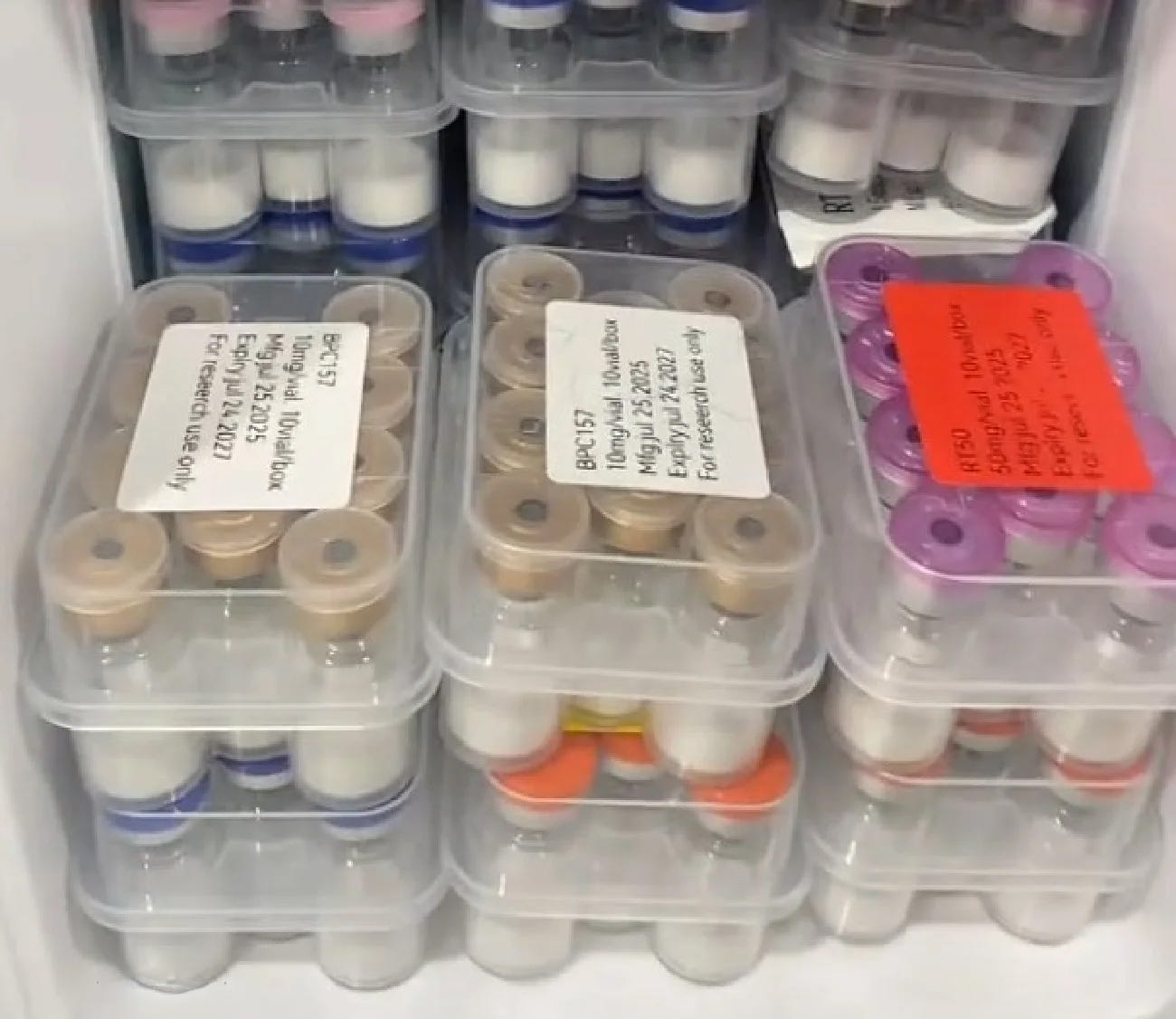
Some have become familiar medicines. Insulin is a peptide. The GLP-1 drugs now transforming the treatment of diabetes and obesity are peptide-based medicines. Other peptides remain laboratory compounds, experimental therapies, compounded preparations, or, increasingly, small vials containing a usually white powder and marked “for research use only.”
How I Entered the Peptide World
I began using peptides after more than four decades of working with health, aging, chronic illness, and the body’s capacity to restore itself.
By the time I began using them, my own physical condition had deteriorated badly.
I had three serious sprains in one knee and two in the other. Each took around a year to approach normal function. For quite a while, I thought I was doing well. Then a rapid deterioration happened. Both knees went from normal to severe pain. I was barely able to walk to my car. I could not carry the equipment I use in my work up a single flight of stairs. Ordinary movement hurt. I could no longer take the daily hikes that had been central to my physical and psychological health.
As my activity collapsed, my weight increased. Walking even a short distance became excruciating. I was taking NSAIDs along with my supplements and herbs. And it was depressing, to say the least.
Though I had always been healthy and had taken excellent care of myself, I felt old age and death rapidly approaching.
That is not dramatic language added in retrospect. It is how my life felt. My world was becoming smaller, my physical independence was in danger of disappearing, and, since I had tried everything I knew from decades of working with people, I saw no route back. The orthopedists were talking about knee replacement surgery, but since I got very ill after a rotator cuff repair, surgery was the last thing I was open to.
I had to try something different, and I couldn’t wait any longer. A researcher, regulator, or pharmaceutical company may regard ten years as a reasonable period for accumulating evidence. Ten years may represent a substantial portion of the capable life I had left.
I was doing all the natural methods of treatment I knew, which, after decades of practicing Asian medicine, was substantial. Yet even that had hit a wall.
I began using peptides and related compounds in an attempt to restore my health.
I decided to combine Western medicine and supplements with peptides. Many researchers or physicians would look at this with some degree of horror. How could I know which treatment helped? I couldn’t. But in my philosophy of healing, all the logical steps toward healing need to be taken so the healing goes as deep as possible and does not offer only superficial, temporary relief of symptoms.
My recovery started shortly after I had PRP injections in each knee. The doctor said I might get some relief for a few months, but I needed better. So I added peptides to my personal protocol. Initially, I used BPC-157, TB-500, and Cartalax. The effects were not instantaneous, but relief started within days. My experiences were overwhelmingly positive. As my knees improved, I added other peptides. Some seemed to do little and were discontinued. In retrospect, I did not take them long enough for them to work. Others produced changes that felt almost miraculous. My recovery was rapid enough that my physicians were shocked by the improvement, not only in my knees, but in measurable biomarkers. Hiking re-entered my life.
It’s been about four years since I started this protocol. I can carry my equipment up and down staircases again. It remains demanding because each suitcase is extremely heavy. The difficulty now comes from the weight of the equipment rather than from a body barely capable of moving itself. I hike four to six miles at a fairly rapid pace almost daily. And there is no pain.
When Anecdotes Become Evidence
Many people in medical research speak dismissively of “anecdotal evidence,” which often begins with someone noticing that the same thing keeps happening.
Ideally, a pattern is observed. Someone proposes an explanation. Researchers then design studies to find out whether the observation holds up.
The discovery of the relationship between Helicobacter pylori and peptic ulcers followed this path.
For much of the twentieth century, ulcers were commonly attributed to stress, lifestyle, excess acid, and personality. Australian pathologist Robin Warren repeatedly observed unusual bacteria in inflamed stomach tissue. Barry Marshall joined him in investigating the pattern.
Marshall eventually swallowed a culture of the organism himself, developed gastritis, and documented the infection. Human studies, epidemiological evidence, and antibiotic-treatment trials later established that H. pylori causes most duodenal ulcers and many gastric ulcers. Marshall and Warren received the 2005 Nobel Prize in Physiology or Medicine for the discovery.
The observation came first. The accepted evidence came later.
Sildenafil followed a similar pattern. It was originally investigated for cardiovascular purposes. An unexpected physiological effect reported during its development redirected attention toward erectile dysfunction, where controlled trials established its value. It became Viagra.
Medicine is full of observations that initially seemed incidental and later became the basis for formal investigation.
One Hundred Thousand Anecdotes
Anecdotal reports do not become formally recognized scientific evidence merely by accumulating.
One person reports a benefit, and the report is called anecdotal.
A thousand people report a similar benefit, and the reports remain anecdotal.
Even one hundred thousand people describing the same improvement will be treated as scientifically inconclusive, though hopefully with curiosity, until the effect has been quantified through accepted study designs and the scientific method.
There are valid methodological reasons for this distinction. People may improve naturally. They may use several treatments at once. Expectations can affect perception. Successful users may speak more often than unsuccessful users. Online communities can amplify certain stories and bury others.
In Part 2, I will go deeper into this as it relates to the current boom in peptide use.
Please take a moment to hit the “like” button below. The more “likes” this gets, the more people will have a chance to see it.
Feel free to share this and any of my other posts.
If something in these words stirred something in you, I’d love to hear it. These conversations matter more than ever, and I appreciate and will do my best to respond to any questions that may arise from reading them. Or if there is a topic you would like me to cover, you can reply here:
And of course, please subscribe if you are not already!
Thanks for writing on this Richard. I consider you very wise and trustworthy. I was glad to see that peptides have been something positive for you as well. After years of struggling with my weight, a GLP-1 has been a game changer for me. Morbid obesity and addiction run in my family so it has been a miracle for me to help with the brain disease that is obesity. Further, I avulsed my hamstring a little over a hear ago - full tear - right off myt pelvis. Turns out approaching 50 isn't a good time to bring the splits back into your life in a hip hop class. I used the wolverine stack injections and with physical therapy as well as sports acupuncture I essentially grew my leg back. I think peptides are some of the medicines of the future.
This is great! Anecdotal evidence can’t be overlooked. I’ve been experimenting with peptides for a few years now. Glad to hear they helped you!