

In Part 1, I described how peptides became part of my recovery from severe knee pain and physical decline.
My knees were better, and my health was back on track. But the curiosity remained: If peptides could help heal knees that had seemed unhealable, what else might they be capable of?
I began exploring other peptides. I would first scour various sites on the internet to learn as much as I could about each one, then introduce it cautiously and pay close attention to how my body responded.
The only unwanted effects were temporary tenderness or pain at the injection site. One compound, FOXO4-DRI, caused enough local pain that I almost stopped using it.
I became fascinated. Names like MOTS-c, CJC-1295, Ipamorelin, Epitalon, FOXO4-DRI, and many others entered my awareness.
So I did what I almost always do when new information captures my attention.
I jumped in.
I didn’t know exactly what would happen, though I'd read enough and talked with enough long-term peptide users to have a high degree of certainty that it wouldn’t be bad.
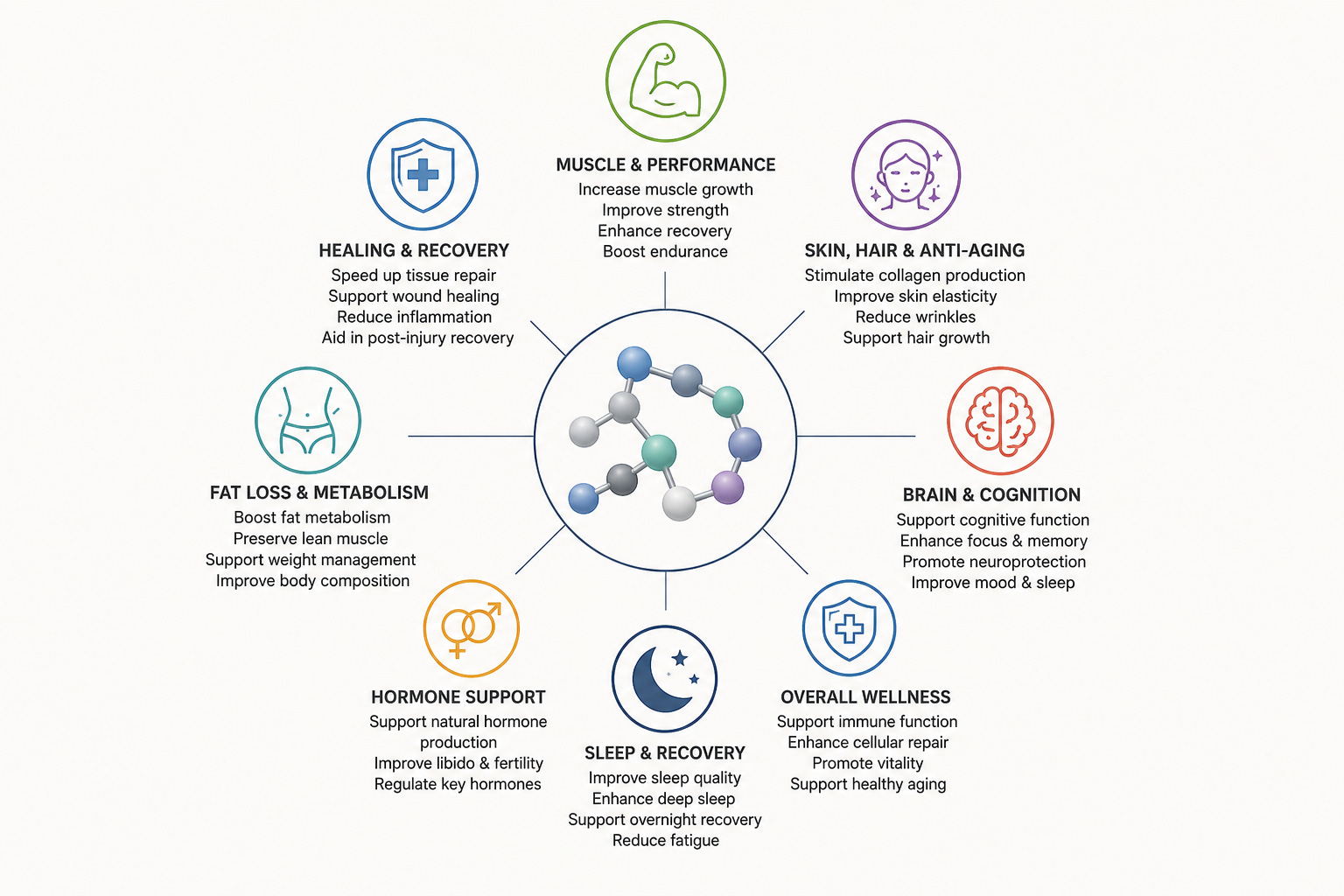
As I started my explorations, my health continued to improve. It wasn't instantaneous; it happened slowly and steadily. I started having more energy and physical stamina. Many minor aches and pains gradually disappeared. My body composition improved, and my thinking felt sharper. So sharp that during this period, I was able to write two books, something I never imagined I could do.
More than anything, I felt many years younger. I was no longer seeing the impossible-to-ignore signs of decline.
The effects were not always obvious. DSIP, a peptide that has been studied for sleep, initially seemed to do nothing. Later, after I began wearing an Oura Ring, I noticed that the nights I used it generally showed a slight improvement in sleep time and sleep quality. The effect was subtle enough that I had missed it without objective tracking.
The better I felt, the more curious I became.
I read more studies, compared protocols, followed experienced users, examined testing reports, and noticed how differently the same peptide could be discussed by researchers, physicians, clinics, and people actually using it.
The only thing that slowed me down was the cost, which was substantial.
That led me to look more closely at where peptides came from, who was selling them, and why a product sold under the same peptide name could cost radically different amounts depending on how it reached the buyer.
I began looking at the peptide market differently.
The Two Peptide Worlds
The official peptide world is found in pharmaceutical development.
A molecule is identified, patented, altered, or otherwise made commercially defensible, tested through successive phases of clinical trials, submitted to regulators, manufactured under controlled conditions, and marketed for an approved use.
This process has produced valuable medicines. It also requires enormous capital, specialized infrastructure, years of work, and a realistic way to recover the investment.
The other peptide world develops when that commercial route is absent.
Many experimental peptides are relatively simple molecules that have appeared in scientific literature for years. Patent protection can be weak, especially when a peptide occurs naturally, is structurally identical to a naturally occurring molecule, or has been known for years.
Some peptides might be used only intermittently. Some have several possible applications without one highly profitable and patentable indication. Others would compete with established drugs. Many can already be synthesized inexpensively outside the branded pharmaceutical system.
Turning a promising molecule into an approved medicine costs a great deal of money. The organization paying for that work generally expects market control and substantial future revenue. Weak patent protection can leave little financial incentive for anyone to carry a peptide through years of trials and regulatory review.
The peptide may then remain frozen for years between laboratory research and clinical use.
Many hear about peptides and begin using them. Physicians encounter patients who are already taking them. Some clinics offer them. Compounding pharmacies also enter the market. Online vendors respond to the demand. Regulators try to restrict access without resolving the scientific questions surrounding the compound.
That unresolved space becomes the gray market.
Many Peptide Users Know What They Are Choosing
Peptide users are sometimes portrayed as naïve consumers who have been misled by internet advertising.
That description does not match most experienced users I have encountered.
Many know that some compounds lack large human trials, standardized prescribing guidelines, conventional approval, or extensive long-term data. They understand that manufacturing quality can vary and that unanswered questions remain.
They still choose to use them.
They weigh those uncertainties against pain, immobility, chronic injury, obesity, fatigue, cognitive problems, metabolic dysfunction, physical decline, and the loss of activities that give their lives meaning.
Most experienced users I know have thought carefully about that decision.
Someone who is rapidly losing function also knows what continued decline feels like and will do what they feel they need to do to slow or reverse that decline.
I understood that calculation personally.
When I could barely walk to my car, waiting indefinitely for institutional certainty or getting a risky surgery was unacceptable. I was losing my physical life in real time.
Many peptide users make a similar calculation and report substantial benefits.
Cost Drives the Market and Creates Risk
Peptides purchased through local clinics, domestic distributors, wellness practices, and other intermediaries can be extremely expensive. Products from Chinese manufacturers may cost a small fraction of the price charged by domestic clinics and distributors. In reality, that is where most peptides originate.
Some protocols may require as much as one vial per day, extended over weeks or months. A single vial can cost up to seventy dollars, and best results often require several adjacent peptides. To ameliorate that often out-of-reach cost structure, many people start looking overseas.
A person may be able to afford several months of a peptide regimen through an overseas source for the cost of a few weeks or even days through a local distributor. Someone using several peptides may save hundreds or thousands of dollars over one treatment course.
On the other hand, domestic sellers may provide consultation, independent laboratory testing, customer service, packaging, inventory, marketing, and some degree of accountability. But the source is likely the same.
The supply chain is rarely transparent enough to know with certainty where any peptide was synthesized, purified, filled, or packaged.
I do need to add that this is not without risk. Often the exact amount of peptide listed on the vial is wrong. If it is less, it will be less effective or ineffective. If it is substantially more, really bad things can happen, especially with the GLP-1s, where too much can cause very serious reactions that could last weeks due to their 5–7-day half-life.
Purity is also an issue. While many companies claim 99% purity, the only way to know for sure is to have a vial from a batch independently tested. Unfortunately, this can cost many hundreds of dollars for one peptide, a cost well out of the reach of many.
Buying a box of syringes on Amazon and injecting oneself is also not without risk. All the peptide users I know of have learned proper injection and cleanliness techniques, but certainly the possibility exists for some, especially those who do not take the time to learn proper techniques, to do serious harm to themselves.
Compounding and Regulatory Pressure
Compounding pharmacies once offered a partial bridge between experimental peptides and ordinary medical care.
A licensed clinician could prescribe an individually prepared medicine for a patient with a particular need. The patient could receive it through a regulated pharmacy rather than an anonymous research supplier.
That route has less available than in the past, though that might be changing for a few of the more common peptides.
The FDA maintains categories of bulk substances nominated for use in compounding and has identified concerns involving several peptides. Its materials include BPC-157 among substances associated with potential compounding risks.
On July 23 and 24, 2026, an FDA advisory committee reviewed BPC-157-related substances, KPV, TB-500, MOTS-c, DSIP, Semax, and Epitalon for possible inclusion on the federal 503A Bulks List. The committee’s role was advisory. Final FDA decisions follow a separate process.
Restrictions can remove a peptide from a licensed compounding pharmacy. They do not remove the manufacturers, online communities, public interest, or the health problems that led people to seek the peptide.
Someone who previously obtained a compound through a domestic pharmacy may turn to a research vendor. Someone who cannot afford the domestic price may order internationally. A clinic that once offered professional guidance may stop participating, leaving the individual to manage the process alone.
The transaction becomes harder to see and less professionally supervised.
How Risk Gets Communicated
I recently saw an article warning that the peptide boom carried a risk of hepatitis. The language created the impression that peptide compounds were causing liver disease. This is highly concerning!
However, when I read the original Hepatitis Queensland statement, it said that sharing needles, syringes, or other injecting equipment, even once, carries a risk of hepatitis transmission. Of course it does. But if it happens, and I consider that extremely unlikely, it’s the user’s fault, not the peptide.
It also can become harder to discuss genuine risks. Excessive dosing, a mislabeled vial, contamination, an unsterile product, shared equipment, and the pharmacological action of the peptide itself may all be described publicly as a “peptide adverse event.”
Given how many people now use gray-market peptides, the near absence of verified serious reactions is worth noticing. Peptide users discuss their experiences constantly on Reddit, social media, and specialized forums, including relatively minor side effects. A hospitalization, severe organ injury, or death plausibly linked to a widely used peptide would almost certainly spread rapidly through those communities, and the media would seize on it.
No such pattern has emerged. Of course, that does not rule out every rare or delayed effect. Time will tell.
Why Peptides Will Remain in the Gray Market
Peptides come from a completely different history than acupuncture or ayahuasca, yet I recognize something familiar. People try these compounds, compare their experiences, and talk about what appears to work long before formal medicine reaches a conclusion.
Some claims will prove exaggerated. Some will be mistaken. Some compounds may ultimately be ineffective or harmful. Other observations may be repeated often enough that researchers begin paying attention.
None of the conditions creating this market are likely to disappear.
Peptide signaling is fundamental to human physiology, and the number of potentially useful compounds is far greater than the number that can realistically complete the pharmaceutical approval process.
The public has direct access to research papers, international manufacturers, laboratory-testing services, online communities, and reports from other users.
Patients and consumers can act far more quickly than institutions. Physical decline can also progress far more quickly than institutions can get approval for new medicines.
Someone in pain, losing mobility, or watching age narrow his life may value five or ten years very differently from a regulatory agency or pharmaceutical company.
International manufacturing keeps prices low enough to sustain demand. Large domestic markups encourage buyers to purchase closer to the source.
Some peptides currently sold through gray-market channels will eventually become approved medicines. Some may fail when properly tested. Others will be replaced by more effective compounds. Many will remain biologically interesting, commercially obtainable, medically unofficial, and legally uncertain.
People who understand those uncertainties will continue using them when they believe that waiting carries a greater cost.
Where I Stand
My own results were unmistakable. Some peptides seemed to do little. Others coincided with changes that felt extraordinary. My physicians saw the speed of my recovery and expressed surprise.
I cannot identify precisely which compound produced each change. I also cannot dismiss what happened to me, or the similar experiences reported by many others, simply because formal research has yet to examine them adequately.
Should you use peptides? Where should you get them? Which ones do you need? These are all questions I cannot answer.
If I get enough other questions on this topic, I’ll continue with a Part 3 to try to address them.
This is an account of my own experience and thinking. It is not medical advice. Anyone considering peptides should do their own research and make decisions with a qualified healthcare professional.
Please take a moment to hit the “like” button below. The more “likes” this gets, the more people will have a chance to see it.
Feel free to share this and any of my other posts.
If something in these words stirred something in you, I’d love to hear it. These conversations matter more than ever, and I appreciate and will do my best to respond to any questions that may arise from reading them. Or if there is a topic you would like me to cover, you can reply here:
And of course, please subscribe if you are not already!
I enjoyed the read! Glad to know you are feeling better and healthier, amigo! Viva
Richard, just sent you a note about this article on peptides...I am very interested, lets make a time to discuss this please.....Greg