

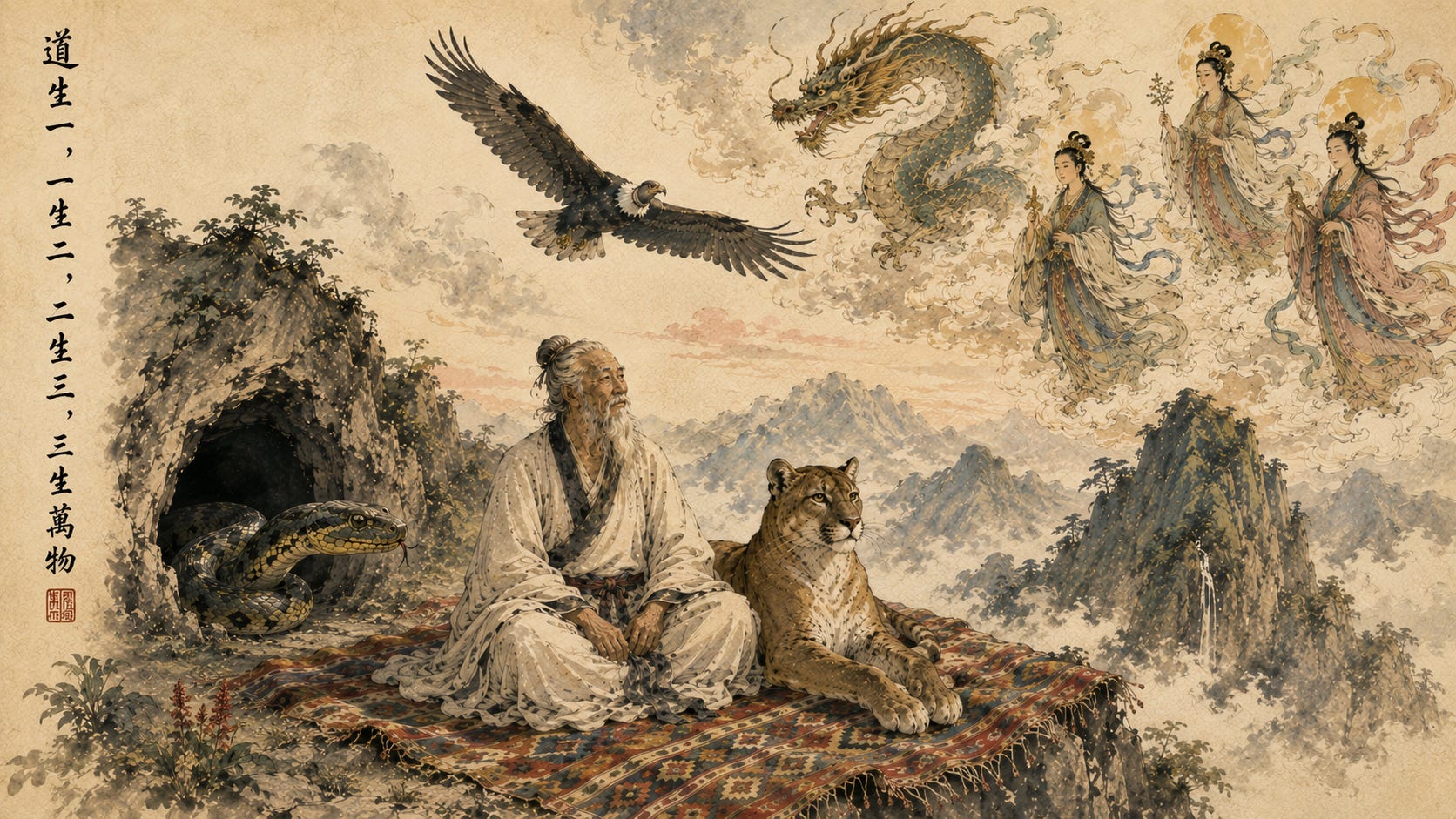
The Tao gives birth to One.
One gives birth to Two.
Two gives birth to Three.
Three gives birth to the ten thousand things.
That is a remarkable amount of cosmology packed into four short sentences, and it begins our journey into “three.”
One is unity, the unformed, the omnipresent. It exists before division, before differentiations, and before the dichotomy of this and that.
Taoism doesn’t say how the one became two, though at least one of the topics we will explore in one of the future pieces in this study will offer a fascinating explanation. But somehow, at an undefined time, there are two. Look around you and see light and dark, male and female, yin and yang, heaven and earth, self and other, life and death, up and down, hot and cold, inner and outer.
Two is pure polarity and can be seen as forces, but forces alone are not enough to sustain a universe and life. So, again, somehow and somewhen, Two became Three, and Three gives us all of creation.
Once there are three, relationship becomes possible. There can be movement, exchange, tension, mediation, a middle. From three, Lao Tzu gets the entire universe. But this is about Three.
I have been thinking about this for a long time and across many cultures and philosophies. Three worlds. Three levels. Three centers. Three qualities. Upper, middle, lower. Heaven, earth, underworld. Head, heart, belly. Cosmic consciousness, ordinary life, the depths that dwell below consciousness.
Different cultures, separated by thousands of miles and sometimes thousands of years, viewed human experience and repeatedly divided it into three. I don’t think they were guarding ancient esoteric secrets that somehow developed around the planet as if inspired and guided by an external force. I believe they were looking at the same thing: us. The human condition, and even how to live a better and richer life. The ten thousand names, no matter the language, refer to something similar. After all, to quote the Bard, A rose by any other name still smells like a rose. Vast wisdom in just nine words, and it has little to do with roses.
For more than forty years, my work has taken me through many very different ways of viewing and understanding human life. The first “three” were when I was learning about Vedic philosophy. Then came Chinese Medicine with its own “three.” Later came the Amazon, plant medicine, ceremony, and the Indigenous traditions I encountered there. More recently, Kabbalah has opened another set of doors. Modern neuroscience has spent the last few decades drawing maps with different names, but strangely similar ideas. The roses certainly smell sweet, and very interesting.
The map that started this noticing of similarities came from the Andes. In Quechua cosmology there are three worlds: Ukhu Pacha, the inner or lower world; Kay Pacha, this world, the world we are walking around in right now; and Hanan Pacha, the upper world.
The lower world is associated with the serpent. The middle world, in the familiar Andean tradition, is associated with the puma. In Amazonian traditions, the jaguar occupies much of this earthly territory. Above is the great bird, the condor in the Andes, the creature that leaves the ground and sees everything from a different height.
At first, this can sound like mythology, an interesting, non-science-based story that non-science-based people tell about how the universe was organized. Then you live with it for a while, and much begins to open.
Ukhu Pacha is the place of the dead, the ancestors, darkness, things underground, things hidden from sight. That begins to sound very much like something inside us. Kay Pacha is the world of embodiment: food, sex, work, children, love, money, illness, arguments, washing the dishes, paying the electric bill, getting your ass out of bed in the morning. Hanan Pacha is the world above: light, spirit, vision, the gods, the heavens, whatever lies beyond the ordinary boundaries of the self.
Everyone has spent time in all three. We just call the rose by a different name.
Anyone who has spent a night grieving someone they loved has been underground. Anyone who has held a child, made love, planted a garden, paid a bill, cooked dinner, or walked five miles through the mountains has been firmly in this world. Anyone who has prayed deeply, meditated, stood before something so beautiful that thought stopped, taken psychedelic medicine, fallen completely into music, or suddenly felt the boundaries of the self dissolve has at least glanced upward.
The three worlds may be cosmology. Looked at differently, they can reflect interior geography.
Somewhere along the way I began noticing other maps. Another three here. Another three there. I started noticing the similarities.
The fit was sometimes beautiful and sometimes imperfect. The imperfect parts became as interesting as the similarities. These traditions arose from different languages, climates, religions, and assumptions about reality. Nobody in ancient India could study Quechua cosmology. Nobody in ancient China had a Peruvian shaman chanting in their ear.
Human beings were studying human beings: the same nervous system, the same body, the same fear, the same ecstasy, the same need to eat, sleep, and reproduce, the same experience of grief, and the same strange moments when consciousness seems much larger than the person carrying it. Different names and maps of the same territory.
This series will explore some of those territories. We will spend time underground, here on this earth, and probably an unreasonable amount of time in the upper realms, since everyone seems to want to go there. We will talk about serpents, jaguars, and condors. We will get to India, China, Kabbalah, Aboriginal Australia, neuroscience, trauma, psychedelics, the ideas of Freud and later psychiatric researchers, and without doubt, more than a few things I haven’t figured out yet.
Part 2 - Ukhu Pacha: The World Below
Please take a moment to hit the “like” button below. The more “likes” this gets, the more people will have a chance to see it.
If something in these words stirred something in you, I’d love to hear it. These conversations matter more than ever, and I appreciate and will do my best to respond to any questions that may arise from reading them. Or if there is a topic you would like me to cover, you can reply here:
And of course, please subscribe if you are not already!
