

Part 1 — Three Worlds, Three Forces, and Finding Three Everywhere
There is a reason we human beings bury things. We bury our dead, waste, secrets, grief, shame, and sometimes entire parts of ourselves we can no longer live with. These are things we try to throw away. But there is no “away.”
We also bury seeds and treasures.
Nearly all societies have stories about what lives underground. Ghosts, demons, spirits, monsters. Many cultures believe it is the home of the dead. It could even be the fires and torments of Hell. Or a place of learning and redemption.
I find this an excellent metaphor for that part of us that could be called the unconscious.
Ukhu Pacha: The Underworld
Quechua-speaking peoples have lived in the high Andes of Peru and Ecuador for well over a thousand years, emerging from cultures whose roots reach back thousands of years further. Much of the older Quechua and Andean religious and philosophical tradition was lost during the Spanish conquest and the centuries of forced conversion that followed. What survives today is substantial, but it is only part of what once existed.
And it remains fascinating, profound, and, seen with the right eyes, deeply meaningful for how we understand ourselves and our world.
In Quechua, the word pacha can mean world, realm, place, time, or space. Today the three-world model is often called Kimsa Pacha, “the Three Worlds,” in Quechua. Its three realms are Hanan Pacha, Kay Pacha, and Ukhu Pacha.
In Andean cosmology, Ukhu Pacha is the inner or lower world. Ukhu carries the sense of inside, interior, beneath. It is the realm of the dead and the ancestors, of caves and darkness, of what lies below the surface and continues its work out of sight.
The connection among caves, the world below, and human origins recurs in Andean traditions. In one of the great Inca origin stories, the ancestors who would found the Inca line emerged from a cave at Pacariqtambo, south of Cusco.
Here, the underworld was also the womb.
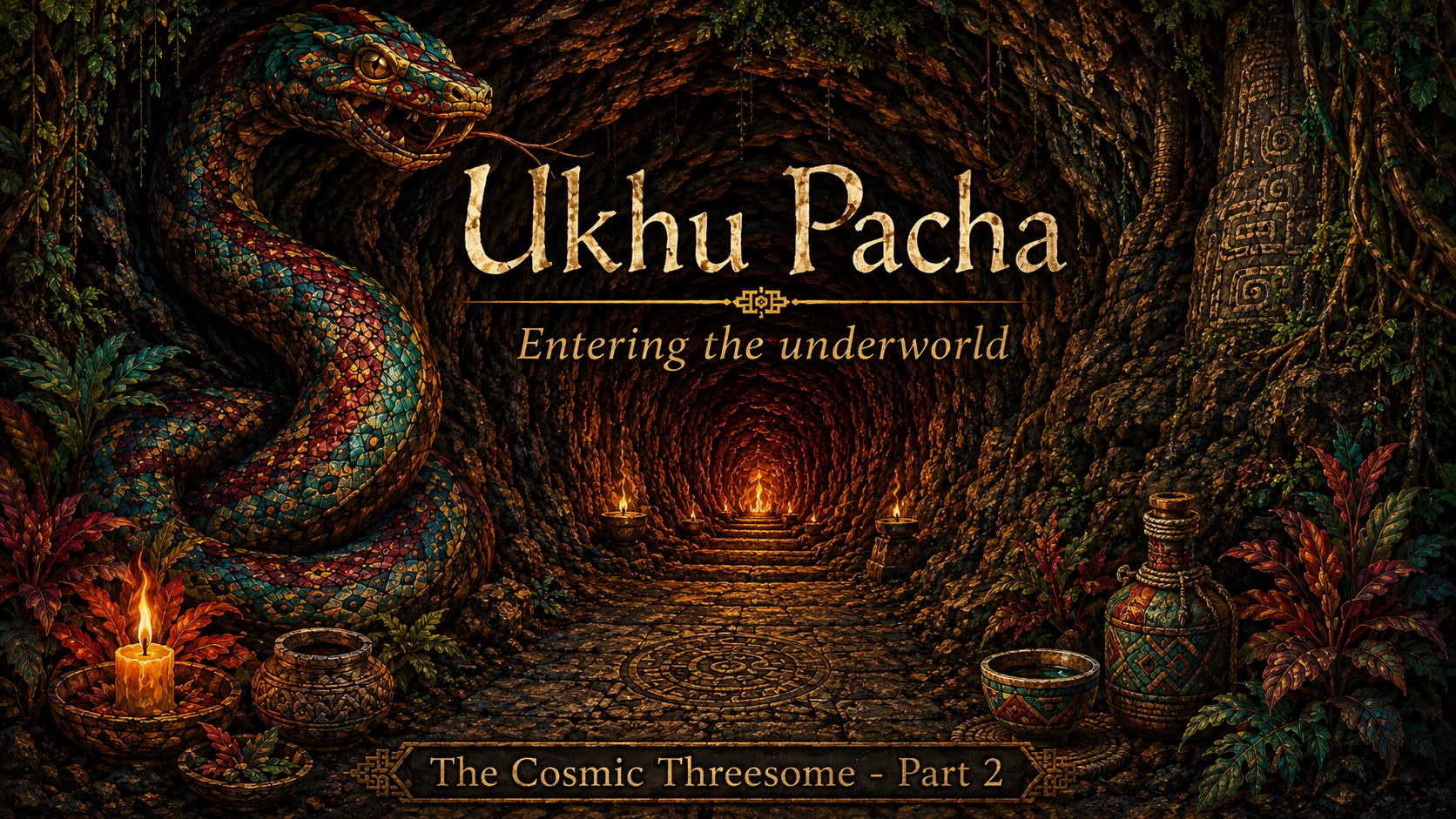
In the three-world teachings I learned, each of the pachas has an animal associated with it. For Ukhu Pacha, the animal is Amaru, the great mythic serpent.
Amaru is an ancient and complicated figure. It is associated with the earth below, subterranean waters, springs, rainbows, storms, fertility, destruction, and renewal. In some traditions, it rises from a spring after the rains, arches across the sky as a rainbow, and returns to the earth through another spring.
Amaru already complicates the idea of a creature belonging to only one world.
A serpent lives close to the earth. It disappears into holes. It sheds its skin. It can kill you, heal you, frighten you, fascinate you, and has accumulated more symbolic baggage than almost any other creature humans have shared the planet with.
In one culture it is wisdom. In another, temptation. Somewhere else it is sexuality, rebirth, death, healing, eternity, life force, or divine knowledge. Sometimes several of these at once.
Anyone who has spent much time around ayahuasca traditions knows how often serpents appear. People who have never given snakes much thought suddenly find themselves surrounded by them, swallowed by them, protected by them, taught by them, or watching them become patterns of light.
The Psychological Underworld
The concept of Ukhu Pacha gave me my first insight into how the three worlds could also serve as a psychological map. I need to back up here and state that this idea is mine, not part of traditional Andean philosophy.
So here we are, standing at the mouth of the cave.
Let’s go deeper.
The unconscious mind is hidden, dark, mysterious, and sometimes dangerous. It is where the things we do not ordinarily see live. It can be where the thoughts we refuse to think do their thinking.
It is where forgotten memories live. It is also where the things that influence us in ways that seem automatic reside. Childhood is there. Old fears are there. Sexuality can be there. Rage is there, as are dreams, instincts, fantasies, impulses, forgotten events, and bodily memories.
One of the things I have heard repeatedly from patients is, “But I handled this years ago.” They could be talking about “handling” it with therapy, medical work, retreats, or seminars. And they did handle it, but perhaps only from the vantage point of Kay Pacha, the Middle World.
The demons of the underworld can still be waiting.
This is the emotional residue of experiences we thought had ended years ago, still influencing us beneath ordinary awareness.
What We Carry
The traumas of the ancestors are there too. We inherit far more than genes: family habits, loyalties, silences, prejudices, addictions, ways of loving, grieving, and pretending there is nothing to grieve.
A child enters the story of their life carrying history that began generations before they were born.
Modern psychology developed its own language for this underground world. Freud made the unconscious central to his understanding of the mind. Jung populated it with archetypes and gave it a collective dimension. Trauma research has shown that an experience can continue shaping physiology and perception long after the thinking mind believes it is over.
Epigenetics has added another layer. Severe stress can leave measurable epigenetic signatures, including changes found in the children of people who experienced extreme trauma. These changes may reflect biological inheritance, prenatal exposure, family environment, or some combination of the three.
Ancient traditions were already thinking in generations. The Torah speaks of the consequences of wrongdoing reaching the third and fourth generation. Some Indigenous traditions in North America place responsibility within a much longer ancestral and generational frame. Epigenetics has given us a biological language for at least part of what older cultures understood more broadly: what happens in one generation may not end there.
Older cultures called these hidden influences spirits, ancestors, demons, ghosts, curses, possession, fate. We now have other words that may sometimes explain more. Sometimes the old image reaches something the technical language misses.
Anyone who has worked with trauma knows how strange memory can be. A person may know perfectly well that something happened thirty years ago. Their body can respond as though it happened thirty seconds ago.
In medicine work, memories long lost to time can resurface. People sometimes also encounter experiences they understand as ancestral memories or events from before this lifetime. What those experiences ultimately are is another question. The experience itself can be extraordinarily powerful.
A smell enters the room. A certain tone appears in someone’s voice. A door slams. Somebody walks too close behind them. Suddenly the heart is racing, the breathing changes, the muscles tighten, attention narrows, and the whole nervous system prepares for something the conscious mind knows is no longer happening.
The mind says, “I’m fine.”
Something underneath disagrees.
That is one reason Ukhu Pacha became so useful to me. An experience can become too large, too frightening, too painful, or too confusing to be fully processed in the moment. Life continues. The person grows older. Years pass. Something remains below the surface, waiting for the right smell, the right voice, the right face, the right loss, the right trigger, or the right moment to come into conscious awareness.
This can be terrifying if it happens with no support or structure. People can believe they are going crazy. In a structured environment, though, where the person has prepared for such experiences and has competent support, the same descent can sometimes be revelatory and deeply transformative.
Descending Into the Cave
Human beings have been telling stories about descent for a very long time. Inanna goes into the underworld. Orpheus descends for Eurydice. Odysseus goes down to speak with the dead. Dante walks through Hell. Shamans descend beneath the earth. Heroes enter caves, tombs, forests, oceans, and the bellies of monsters.
They usually go because something is there that must be found, faced, learned, released, or brought home.
There are rooms inside ourselves we avoid because some part of us already knows what is there. Grief that never finished. Shame that still burns. Anger we were never allowed to feel. Fear that once kept us alive and never received the message that the danger had passed.
Real healing sometimes, perhaps often, requires voluntarily entering the cave and exploring its depths.
I have seen this many times in ceremony. Someone enters grief, terror, heartbreak, or a memory so powerful that it fills the whole room. The emergence of this material is a great gift. The medicine can open doors to experiences and emotions that have been buried for years.
I sit beside them. I breathe with them. Sometimes a song needs to be sung. I stay centered enough that their darkness does not frighten me into trying to pull them out before they are ready. Even the conviction that they are finished can sometimes be another way of running out of an unexplored cave.
Something eventually shifts. It may happen through crying or purging. A song may reach a place language cannot reach. A person may finally allow themselves to feel something they have spent thirty years avoiding and discover that the feeling itself does not kill them.
Sometimes nothing dramatic happens at all. Months later they tell you that something that had owned them for years no longer has the same grip.
I have seen that often enough to know it is real.
Shedding the Old Skin
The snake’s old skin becomes too small. The animal rubs against the world until it splits, then crawls out of it.
Real psychological change can be very much like that. An identity that once worked begins to fit badly. Old habits become constricting. Relationships shift. Beliefs stop making sense. The person knows that something is ending long before there is any clear sense of what comes after.
And the old skin continues to shed.
Ukhu Pacha is associated with death, but underground death is rarely sterile. Roots grow in darkness. Compost becomes soil. Bodies return to earth and become part of other bodies. Decomposition is one of nature’s great creative acts.
We have given darkness a bad reputation, especially in modern spiritual culture. Everyone wants light, higher vibration, ascension, positivity, transcendence, love and light.
Light is lovely. It also occupies only half of the day.
Seeds do not germinate in the sky. Babies develop in darkness. Sleep happens in darkness. The body does a great deal of its repair when consciousness gets out of the way.
Grief has a function. Anger has a function. Fear has a function. Even shame carries information before it hardens into something destructive.
There is also a real danger in staying underground too long. Depression can become the filter through which all of reality is perceived. Trauma can become identity. Grief can become the only remaining relationship with someone who died. Anger can become the organizing principle of a life.
Ukhu Pacha can become home when it was meant to be a place we visit. Freedom comes when the tomb becomes a womb.
A healthy person can descend and return. They can grieve without becoming grief. They can feel anger without building their lives around it. They can enter fear and still remember that fear is something that can move through them.
There are times to descend. There are times to stand on the earth. There are times to rise.
Trouble comes when movement stops.
Underworld stories often include guides for a reason. Virgil guides Dante. Hermes escorts souls. Shamans travel with animal helpers. The dead themselves sometimes become teachers.
In ceremony, one of the most useful things I can say to somebody who is frightened is very simple: “It is OK to be afraid. It’s not OK to let the fear own you.”
Often that is enough.
Where the Ancestors Dwell
Ukhu Pacha is also the world of ancestors, and I think our culture gives far too little attention to what the dead leave behind.
We like to imagine ourselves as individuals who begin at birth and construct a life from there. We arrive carrying an enormous amount of history.
Some of it is biological. Some is familial. Some is cultural. Most of it is so tangled together that separating one from another may be impossible.
We inherit recipes and religions, gestures and prejudices, courage and terror, ways of touching and ways of refusing to touch. Families pass stories down openly, and they pass others down by never speaking about them at all.
Silence can be one of the strongest forms of inheritance.
An ancestor does not have to appear at the foot of the bed to haunt a family. A behavior repeated for five generations will do nicely.
So the old image of the ancestors living below us and inside us has more substance than it first appears to have. We are built from the dead. We carry them physically, psychologically, culturally, and perhaps in other ways that I am happy to leave open.
Where Amaru Waits
Every underworld also has an entrance. A cave. A grave. A well. A crack in the earth.
Our entrances can be almost anything.
A dream. A smell. A death. A breakup. A diagnosis. A psychedelic medicine. A piece of music. A child asking a question we cannot answer.
Sometimes we enter deliberately. Sometimes the floor gives way.
Either way, there is a point when ordinary daylight disappears and the eyes have to adjust.
That is where Amaru waits.
The serpent of Ukhu Pacha belongs to the depths, but it does not remain there. It rises. What was hidden comes into view. What was buried enters the world of ordinary life. The movement itself becomes part of the transformation.
There are things underground that can hurt us. There are also things we left there because, at the time, we were too young, too frightened, too overwhelmed, or simply unable to carry them.
Some have been waiting a very long time.
And sometimes, when we finally go far enough down, the monster we fear turns out to be something that has been waiting for us to become its friend.
Please take a moment to hit the “like” button below. The more “likes” this gets, the more people will have a chance to see it. It also lets me know this is being read!
If something in these words stirred something in you, I’d love to hear it. These conversations matter more than ever, and I appreciate and will do my best to respond to any questions that may arise from reading them. Or if there is a topic you would like me to cover, you can reply here:
And of course, please subscribe if you are not already!
And finally, if you would like to work with me, or just send a message, click below.

Thank you, Mitch. That means a lot.
A next book is under consideration. Perhaps just a collection of the Substack posts. We'll see.
Very compelling piece. Evocative and meaningful to me. Thanks. Really well written. Is this part of a book you will be publishing or have published?