

Many years ago, before the Internet took its current form and when I was studying Chinese Medicine, I was spending a Sunday afternoon by the beach with some friends. We were inside a house in Malibu, across the street from the ocean. Late afternoon came, and we decided to walk to the beach for sunset. Someone opened the door, and we stepped outside.
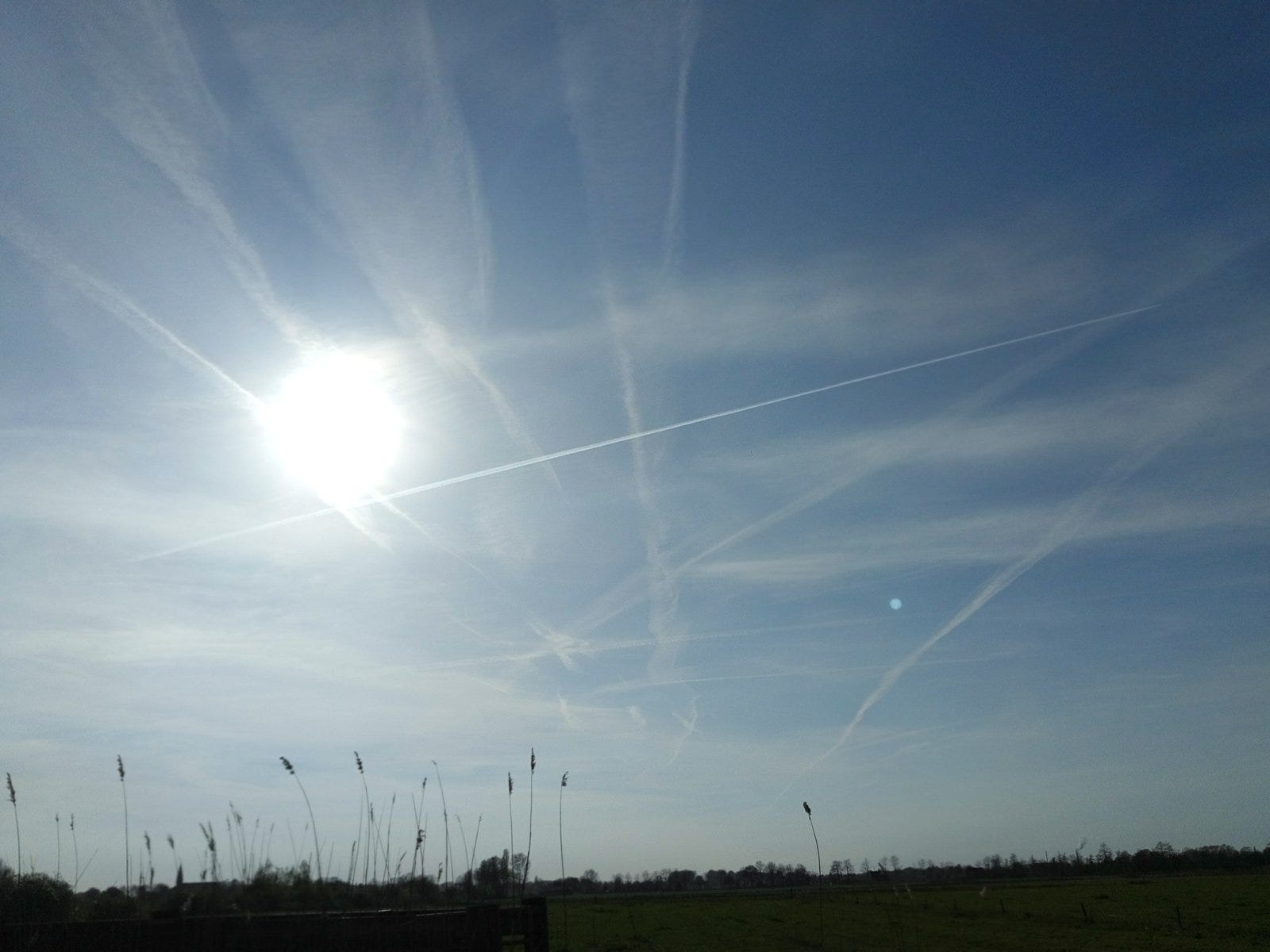
I took a deep breath, thankful to finally be outside on a beautiful late-spring day. I noticed that the sky was marked with white lines. They crossed at angles. Some were sharp. Others had already softened and spread. The pattern extended across the entire sky, from one horizon to the other.
One of the people with us looked up and immediately said, “Oh my God, they are spraying chemtrails! This is going to make me sick.”
I had only recently heard about chemtrails from a person sitting behind a table covered with handwritten placards and fuzzy photos of trails left by “them.” “California,” I thought, bemused by the scene. I thought nothing further of it.
Now I was standing next to someone who fully believed it. At first, I thought he was joking. Within seconds, his body changed. His breathing shifted, his eyes watered, and his posture tightened. He described irritation and pressure, as if he were being poisoned. His presentation matched a strong allergic response combined with anxiety.
I looked up at the lines, which I recognized as typical contrails. They were at cruising altitude, roughly 30,000 to 40,000 feet above sea level. That is about 6.5 miles of air between the ground and where the jets were flying.
I explained that the trails are made of ice crystals formed from water vapor in jet exhaust at low temperatures, and that they do not descend as intact, concentrated plumes to ground level. Even if anything reached the ground, it would be highly diluted and would fall far from where the trails formed.
Unfortunately, he held to his belief that they were poisoning us, and his symptoms intensified.
He excused himself and went home, where filtered air would provide relief.
The response in front of me was real. He became ill. There was no question about that. The cause of his symptoms lay in interpretation rather than anything moving down from those lines in the sky.
The Lines in the Sky
Jet trails appear close, though they are not. The sky provides no scale reference, so the observation of distance compresses, and a thin line can look like it sits just above you, even though it does not.
At the altitude where these trails form, the line of sight extends hundreds of kilometers. At sea level, when both horizons are visible, each horizon point is roughly 350 to 400 kilometers away. A contrail that runs from horizon to horizon can span about 700 to 800 kilometers, roughly 430 to 500 miles.
That scale is not apparent to the eye because the ends of the line are far away, the width is small compared to its length, and perspective compresses distance near the horizon. The sky offers no objects to anchor size.
Time adds another layer. A jet at cruising speed moves around 450 to 550 miles per hour, so to traverse 450 miles would take close to an hour, yet that is not what is experienced. The aircraft is clearly visible for only a limited portion of the path, often for around ten minutes, while parts of the trail may be twenty to forty minutes old. What is seen is composed of different moments along the aircraft’s path, though the eye reads it as a single event.
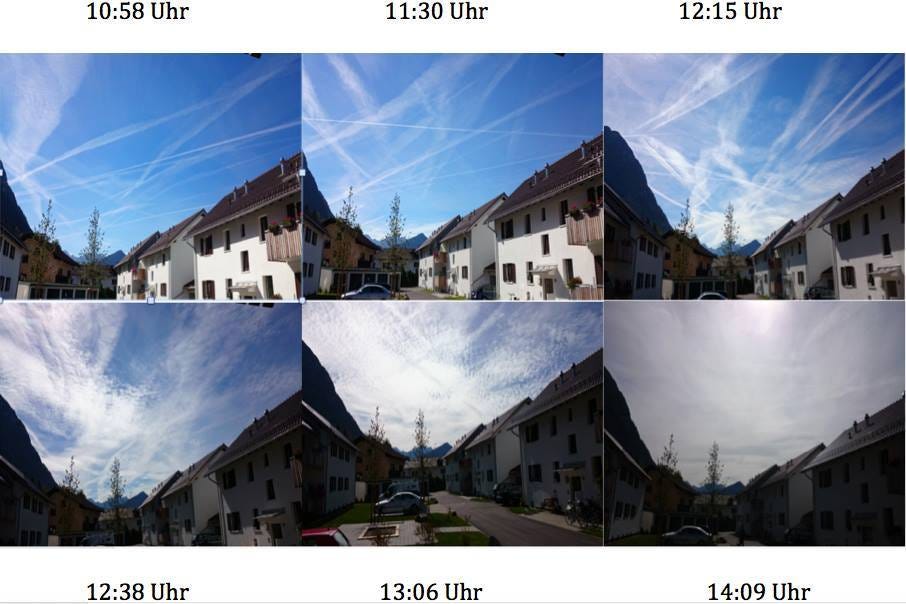
Contrails fall into two broad categories. Some are non-persistent, forming and then disappearing quickly because the surrounding air does not support them. Others are persistent, forming in the air that can sustain the ice crystals, allowing them to remain visible for longer periods, spread in the wind, widen, and sometimes merge with other trails into thin cloud layers.
In regions with heavy air traffic, multiple aircraft passing through favorable atmospheric layers can produce crossing patterns that appear structured.
In Malibu, several trails intersected in the same part of the sky, with some fresh and others older, creating a strong visual effect.
The statement “chemtrails” assigned meaning to that pattern, and his bodily response followed quickly.
The Nocebo Effect
There is a known mechanism for this type of response, often referred to as the nocebo effect. The word nocebo is relatively recent, coined in the 1960’s and entering common parleance in the 2000’s.
Observations like this are not new. Long before the term nocebo was coined, physicians and thinkers across cultures described the same pattern in different language. In the tradition of Hippocrates and later Galen, there are repeated notes that a patient’s expectation can shape the course of illness, and that fear can intensify symptoms even in the absence of a clear external cause. In classical Jewish sources, including the Talmud, there is a consistent recognition that a person’s inner state can lead them toward harm or health. In early Chinese medicine, as recorded in the Huangdi Neijing, emotional and mental states are understood to move the body directly, altering function and producing physical effects. Across these traditions, the language differs, though the observation remains the same. What is perceived and believed does not remain confined to the mind. It moves into the body and takes form there.
Expectation can trigger a cascade of physiological changes in which the brain interprets a perceived threat and initiates a response that alters breathing, increases muscle tension, and generates physical sensations. In individuals with sensitivity to allergies or anxiety, the response can closely resemble direct exposure.
The timing in that moment fits that mechanism, as the response began within seconds of recognition. The body does not require an external substance to produce a real reaction. Interpretation can be sufficient.
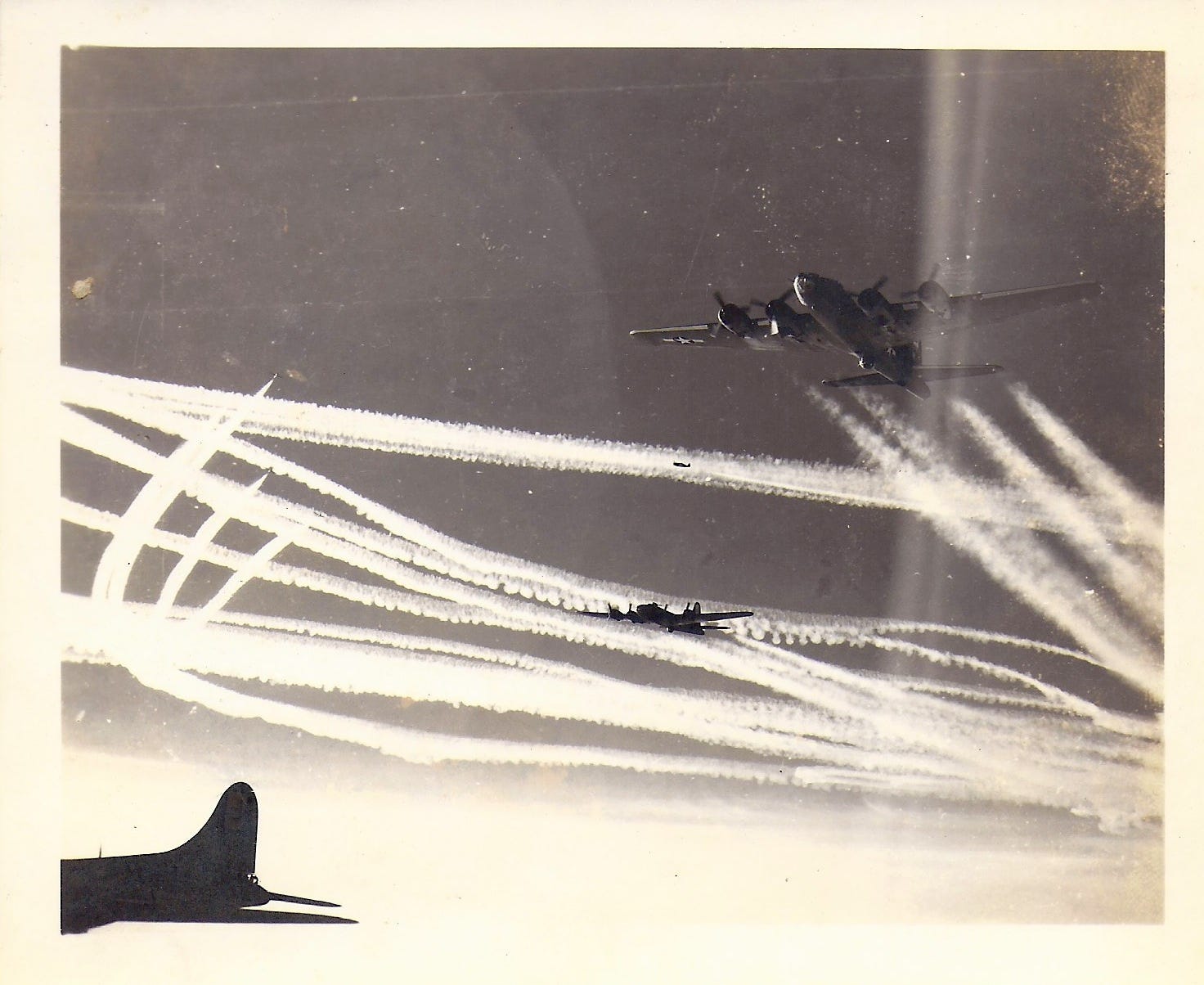
There is also nothing new about the trails in the sky. During World War II, long before modern aviation, photographs show skies filled with dense, crossing contrails left by multiple aircraft flying at altitude. The patterns look structured, even deliberate, though they arise from ordinary flight paths combined with atmospheric conditions.
Seen without context, those images carry the same visual weight. Lines crossing, widening, layering. The same kind of sky that can trigger a strong reaction in the present.
What a Deliberate Scenario Would Require
Consider what would be required if those lines represented a deliberate, large-scale operation as many believe.
A single regional criss-cross pattern over a large area would require multiple aircraft operating within a defined time window. A plausible scenario would involve around fifty sorties over several hours, with each aircraft carrying about 2,000 kilograms of material to produce a strong visible plume. The total material would amount to about 100,000 kilograms (100 metric tons) for one day in one region.
That amount of material does not appear on its own. It would need to be manufactured, which would require raw materials, processing equipment, quality control, and trained personnel. Even at a basic level, that implies several dozen people working behind the scenes to produce and handle it.
Once produced, it would need to be stored and managed. Tanks or containers, loading systems, and inventory tracking would be required, along with another group of people responsible for maintaining and moving that stock. From there, it would have to be transported to the airport through coordinated trucking and scheduling, adding another layer of logistics and another set of personnel.
At the airport, the operation would become more visible. The material would need to be staged and loaded onto aircraft using specialized equipment, all while coordinating with normal airport activity. For around fifty flights, this alone would involve a few hundred ground crew working in concert.
The aircraft themselves would need to be equipped to carry and release the material. That implies tanks, pumps, plumbing, controls, and ongoing maintenance.
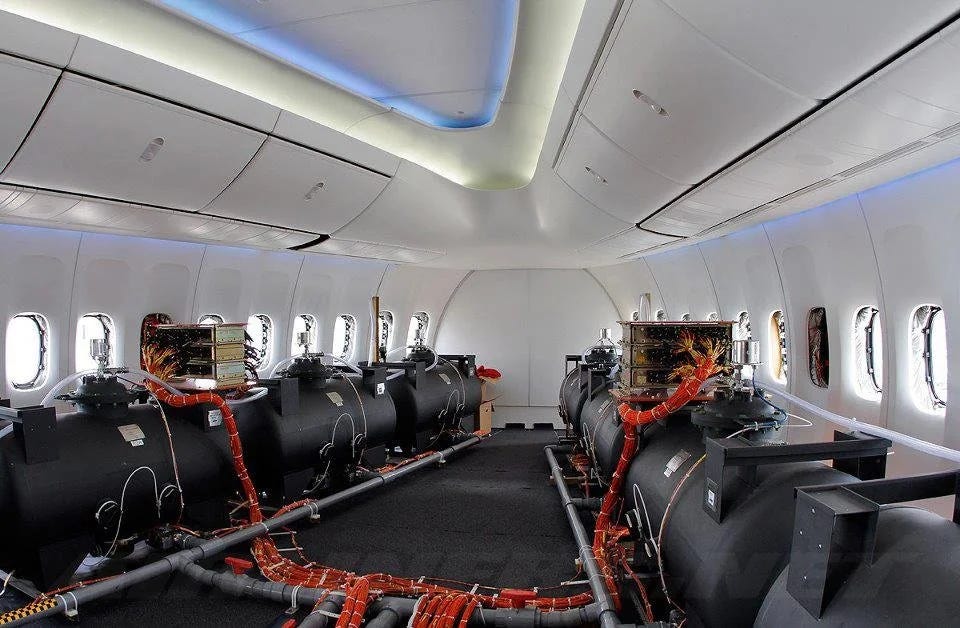
When aircraft are configured to carry large volumes of liquid, the systems required are substantial. Tanks, reinforced mounting, plumbing, control systems, and maintenance access are all necessary.
Mechanics and technicians would be responsible for inspecting and servicing these systems, involving on the order of 100 to 150 people. Pilots would then operate the aircraft, with two per flight, leading to about 100 pilots for fifty sorties.
Around this core activity, additional roles would be required to keep the system functioning. Dispatchers would plan and coordinate flights, meteorology support would identify suitable atmospheric conditions, and supervisors, safety personnel, and administrative staff would oversee the operation.
Taken together, even a single regional one-day event begins to involve a large number of people moving in coordination. A reasonable estimate is 600 to 1,000 individuals across all roles.
The cost follows the same pattern. The material for 100 metric tons could range from a few hundred thousand dollars to around $2 million. Aircraft operations for fifty flights could range from about $750,000 to $2 million, with fuel adding another $200,000 to $500,000. Ground operations, maintenance, storage, transport, and handling would each add additional layers of cost, along with the engineering and equipment needed to support the system. When combined, the total for a single regional one-day event ranges from about $2 million to $7 million.
If extended over a full year in one region, the scale increases. Material alone would total about 36,500 metric tons annually, with costs ranging from about $730 million to $2.55 billion. Staffing would shift into a continuous operation with permanent roles across manufacturing, logistics, airport operations, maintenance, procurement, and administration, keeping the number of people involved in the hundreds to low thousands.
Expanding outward, a global version of this idea grows quickly. With 50 to 100 regions active per day, the system would require approximately 2,500 to 5,000 flights daily and 5,000 to 10,000 metric tons of material each day. Over a year, that becomes about 1.8 to 3.65 million metric tons.
A workforce of approximately 30,000 to 100,000 people would be required to sustain such an effort, with daily costs ranging from about $100 million to $700 million and annual costs from about $36.5 billion to $255.5 billion. Definitely not small change.
At that point, the operation would resemble a large industrial network. It would require manufacturing facilities, transport systems, storage depots, airport infrastructure, aircraft modification programs, maintenance operations, procurement systems, accounting, and regulatory interaction across multiple countries. It would generate contracts, invoices, payroll, and supply chains that leave a clear and continuous trail.
That scale would still be small compared to what would be required to affect the climate, which could involve a minimum of around 300 regions spread out across the planet.
Air traffic control would also be part of that footprint. Every aircraft is tracked from takeoff to landing through a global network of controllers, including tower, departure, approach, en route, and oceanic sectors, as well as supervisors and coordination staff. This system involves tens of thousands of professionals worldwide.
As Benjamin Franklin put it, “Three may keep a secret, if two of them are dead.”
Closing
That moment in Malibu has stayed with me. A marked sky, a single interpretation, and a body that responded immediately. The reaction was real. What stood out was how quickly interpretation moved into physiology.
Experiences like that do not remain isolated. The same pattern can extend into many areas of thought, where an image appears, meaning is assigned, and the body organizes itself around that meaning. The process is fast and often unnoticed, yet repeated often enough, it begins to shape a person’s ongoing state.
There are many ideas in circulation that carry this kind of charge. Each one can occupy attention, generate concern, and produce a physical response. In some individuals, the accumulation becomes significant, filling the mind with perceived threats and keeping the body in a continuous state of reaction. Over time, this can narrow a person’s sense of ease.
As a healer and as a medicine carrier, my goal is to bring freedom, release from imagined fears is a real step toward deep personal freedom. Inner freedom is a huge step on the path to self-realization, joy, and Love.
Seems a pretty good plan!
Thank you for reading. These pieces mean a lot to me, and for you, I put a lot of heart and time into them. May we all learn and strive to be that breath-breathing human being.
Please take a moment to hit the “like” button below. The more “likes” this gets, the more people will have a chance to see it.
Feel free to share this and any of my other posts.
If something in these words stirred something in you, I’d love to hear it. These conversations matter more than ever, and I appreciate and will do my best to respond to any questions that may arise from reading them. Or if there is a topic you would like me to cover, you can reply here:
I hope that through reading this, the soft, still voice within you will be a little easier to hear today.
I have chosen not to have any material behind paywalls, but I still appreciate any help you can give. To help support this writing, you can make a one-time contribution. It helps a lot.

#ThinkForYourself #QuestionEverything #BreakTheSpell #BeliefIsNotTruth #StayAwake #ResistTheHiveMind #LogicOverLies #nocebo#placebo#Chemtrails#DangerOfCertainty #FreeYourMind#FreeYourHeart
So, how can you see aircraft producing contrails and aircraft producing 'chemtrails' in the same air space? Is it just a case of height? And what of governments (including many ariund the world) confirming the use of atmospheric geoengineering?